
 by Artist (758)
Thornton Dial, Sr.
American, 1928–2016
Alabama native Thornton Dial Sr. spent most of his life working as a machinist in a railcar factory in Bessemer, Alabama. After being laid off in 1977, he began to use his mechanical skills to create sculptural objects with cast-off materials he had found. Dial made more than 500 pieces of wall-relief sculpture and more than 2000 drawings and watercolor paintings.
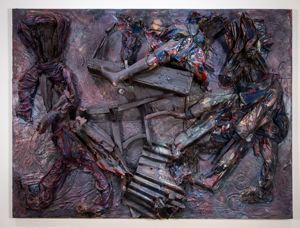
In this 2008 artwork, the artist recognized that 20th century American society was characterized by a tendency for violence as a result of deep cultural discord, leaving some of its citizens lost, disconnected, and left behind. For this work, Dial utilized scrap materials found along the railroad tracks. Initially, he painted the work with traditional American colors but later painted it brown to represent unheard voices that had perished, stating: “You can’t destroy life. God put those people on earth and they’re still here today.”
American, 1928–2016
Lost Americans
2008
Object Type:
Mixed Media
Dimensions:
72 x 96 x 13 1/2 in. (183 x 244 x 34 cm)
Medium and Support:
Mixed media on wood
Accession Number:
2021.0004.0002
Credit Line:
Montgomery Museum of Fine Arts Association Purchase and Gift of the Souls Grown Deep Foundation from the William S. Arnett Collection
Currently On View
Copyright:
© Estate of Thornton Dial / Artists Rights Society (ARS), New York
Alabama native Thornton Dial Sr. spent most of his life working as a machinist in a railcar factory in Bessemer, Alabama. After being laid off in 1977, he began to use his mechanical skills to create sculptural objects with cast-off materials he had found. Dial made more than 500 pieces of wall-relief sculpture and more than 2000 drawings and watercolor paintings.
In this 2008 artwork, the artist recognized that 20th century American society was characterized by a tendency for violence as a result of deep cultural discord, leaving some of its citizens lost, disconnected, and left behind. For this work, Dial utilized scrap materials found along the railroad tracks. Initially, he painted the work with traditional American colors but later painted it brown to represent unheard voices that had perished, stating: “You can’t destroy life. God put those people on earth and they’re still here today.”
Portfolio List
Click a portfolio name to view all the objects in that portfolio
This object is a member of the following portfolios:

Your current search criteria is: All Object records.