Classification: Painting
| Showing 1 of 1 |
|

Abraham Rattner
American, 1893–1978
Rattner was born in Poughkeepsie, NY and studied at the Corcoran School of Art and Pennsylvania Academy of Fine Arts. He served as a camouflage expert in World War 1 and that experience may have influenced his subsequent painting style with its faces and figures that seem to dissolve and reappear amidst fractured painting surfaces. An Expressionist, he absorbed Cubist and Futurist influences, rendering his commentary on the human condition in high-keyed color on countless canvasses. His themes range from crucifixions to landscapes. His abstracted figurative forms with their roughly encrusted surfaces evoke a vulnerability wholly understandable to his contemporaries who had seen the horrors of The Great War, the rise of Nazi Germany, Hiroshima, and Nagasaki. The angular forms and brilliant sparking colors, defined by thick black lines are highly characteristic of Rattner's work. He returned to the United States just before the outbreak of World War Two after living and working in France for more than 20 years. His style was refined there by exposure to the works of the School of Paris artists represented by the works of Pablo PIcasso and Juan Gris.
American, 1893–1978
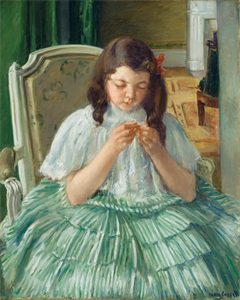
Composition with Three Figures
1952
Object Type:
Painting
Dimensions:
35 1/4 in. x 45 3/4 in. (89.54 cm x 116.21 cm)
Medium and Support:
Oil on canvas
Accession Number:
2006.0010
Credit Line:
Gift of Babette L. and Charles H. Wampold
Copyright:
Copyright held by Leepa-Rattner Museum of Art, St. Petersburg College, Tarpon Springs, FL
Rattner was born in Poughkeepsie, NY and studied at the Corcoran School of Art and Pennsylvania Academy of Fine Arts. He served as a camouflage expert in World War 1 and that experience may have influenced his subsequent painting style with its faces and figures that seem to dissolve and reappear amidst fractured painting surfaces. An Expressionist, he absorbed Cubist and Futurist influences, rendering his commentary on the human condition in high-keyed color on countless canvasses. His themes range from crucifixions to landscapes. His abstracted figurative forms with their roughly encrusted surfaces evoke a vulnerability wholly understandable to his contemporaries who had seen the horrors of The Great War, the rise of Nazi Germany, Hiroshima, and Nagasaki. The angular forms and brilliant sparking colors, defined by thick black lines are highly characteristic of Rattner's work. He returned to the United States just before the outbreak of World War Two after living and working in France for more than 20 years. His style was refined there by exposure to the works of the School of Paris artists represented by the works of Pablo PIcasso and Juan Gris.
Keywords
Click a term to view the records with the same keyword
Portfolio List
Click a portfolio name to view all the objects in that portfolio
This object is a member of the following portfolios:
Your current search criteria is: Portfolio is "Classification: Painting" and [Object]Century is "Twentieth century" and [Object]Display Artist is "Abraham Rattner".